PARK Academy Alumni event
- 04.02.2026
- 17:00 h
- Online
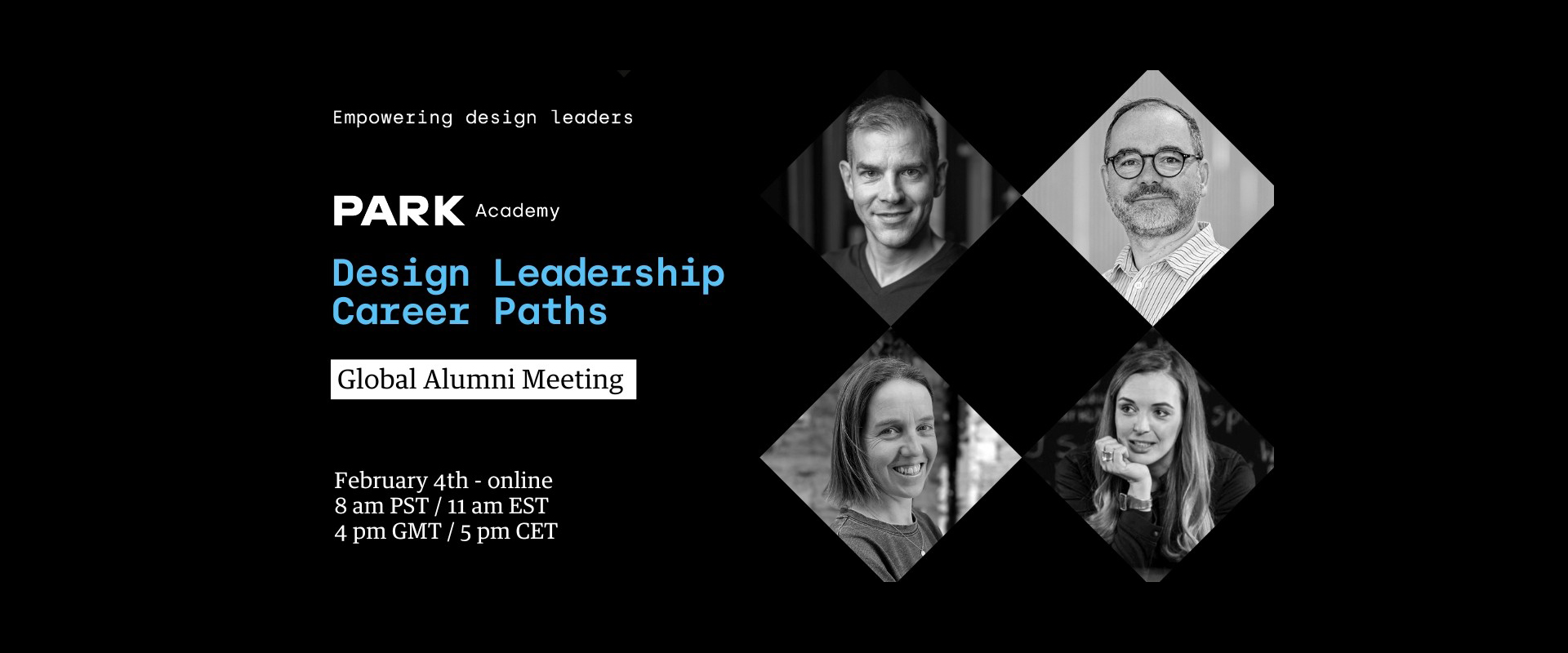
On 4th of February 2026 85 PARK Academy alumni from around the world came together for our annual global alumni meeting, united by a shared question: what does it really take to become a high impact design leader?
Hosted by PARK Directors James Hall and Andy Sharpe, this year’s session explored the realities of design leadership through honest, personal stories from four alumni speakers. Different industries, different career paths, one common ambition: advancing design leadership with high impact.
A shared framework: The High Impact Design Leader
The session was framed around PARK’s High Impact Design Leadership model, which brings together three critical dimensions of leadership:
#Creative Intelligence (CQ): how we think, imagine, and create
#Emotional Intelligence (EQ): how we show up, connect, and lead people
#Business Intelligence (BQ): how we drive decisions, performance, and outcomes
Rather than treating these as abstract capabilities, the model served as a reflective lens throughout the session. Alumni were invited to consider which dimensions had shaped their leadership so far, and which might matter most in the next chapter of their journey.
Theme: Navigating the Design Leadership Journey
Four different journeys, one shared mission - advancing design leadership.
1. Trusting your judgment and voice
Eimear O’Sullivan, Creative Director and Head of Design at The Public House, opened the session by reflecting on how leadership often arrives before we feel ready.
Early responsibility taught her that authority alone is rarely enough. Listening deeply, creating trust, and navigating uncertainty through emotional intelligence enabled her to lead effectively in complex situations. Over time, relationship building emerged not as a soft skill, but as a strategic one, supporting credibility and influence across clients and stakeholders.
As her career evolved, Eimear highlighted the importance of strengthening business intelligence alongside creative and emotional capabilities. Learning to engage more confidently in senior conversations helped reposition design as a strategic contributor rather than a purely executional function.
Her core takeaway resonated strongly. As execution becomes cheaper, judgement becomes more valuable. Design leaders are not in the room by chance. Trusting your voice and using your perspective responsibly is central to high impact leadership.
2. Staying curious instead of certain
Janina Forberger, VP of Design Center at Miele, traced her leadership philosophy back to deeply held values shaped early in life. Respect, responsibility, and humility formed the foundation of how she approaches leadership, not as hierarchy, but as stewardship.
A recurring theme in her story was curiosity. From childhood through to senior leadership, Janina described curiosity as a conscious practice rather than a reflex. Staying open, asking questions, and challenging assumptions allowed her to grow beyond fear, whether that meant speaking up, moving countries, or stepping into unfamiliar roles.
She reflected on the realisation that strong ideas alone are not enough. Timing, organisational readiness, and business context all shape whether ideas can succeed. Learning to understand systems, constraints, and stakeholder motivations became as important as creative excellence.
As her career evolved, leadership shifted from making to enabling. Coaching others, building trust, and adapting to different personalities required emotional intelligence and restraint. The moments that changed her most were consistently outside her comfort zone, where personal, organisational, and cultural discomfort became catalysts for growth.
3. How to fast track development
Leon Korošec, Senior Vice President at Elan Sports, shared a business leader’s perspective on accelerating development in environments defined by tight timelines, complexity, and risk.
Leon spoke about the conditions that make speed possible. Strong foundations, including clear processes, shared language, and continuous investment in capability, allow organisations to move faster without compromising quality.
He emphasised the need to balance business, creative, and emotional intelligence when navigating moments of uncertainty. When teams are aligned around purpose and priorities, momentum can be sustained even under pressure.
Fast tracking, Leon argued, works best when framed as both a business challenge and a personal achievement, creating focus, motivation, and collective ownership.
4. Innovation as a mindset
Søren Lethin, Innovation Catalyst at the LEGO Group, closed the speaker contributions by reframing innovation as a leadership mindset rather than a linear process.
Drawing on decades of experience at LEGO, he described how innovation succeeds when leaders move fluidly across emotional, creative, and business intelligence. Deep empathy for people and problems comes first. Only then can creativity be channelled effectively, and business value realised.
At LEGO, this is expressed through three simple modes. Be curious when qualifying opportunities. Be brave when exploring new territories. Be focused when incubating value. Together, these mindsets help teams align around shared learning rather than fixed solutions.
Søren emphasised that leaders gain traction not by selling ideas, but by building shared understanding. When teams rally around insight and purpose, innovation becomes collaborative, credible, and scalable.
One conversation, many journeys
The session closed with a fast-paced panel discussion, bringing together all four speakers to reflect across Creative, Emotional, and Business Intelligence.
What became clear was that there is no single path to high impact design leadership. Careers evolve through different phases, shaped by context, challenge, and choice. What matters is the ability to recognise which capabilities are needed now, and to keep developing them intentionally.
Over the coming 12 to 18 months, PARK will be releasing a connected series of articles that build on these themes in more depth. Together, they will explore the practices, mindsets, and trade-offs behind high impact design leadership, forming a practical handbook for anyone navigating a leadership role in design.
For many alumni, this session served as both a mirror and a provocation: a chance to reflect on how far they have come, and to think more clearly about what comes next.
Thank you to all our alumni speakers and participants for contributing so openly and generously to this year’s conversation. We look forward to continuing the journey together.
The next PARK Academy Programm 2026 in Germany - Helping grow design leadership capability and competency for VDID members - will start on 10. & 11. March 2026 in Hamburg.
Carola Boogerd, PARK Academy team
Abonniere den VDID Newsletter
Trage Deine E-Mail-Adresse hier ein, um den VDID Newsletter zu abonnieren.